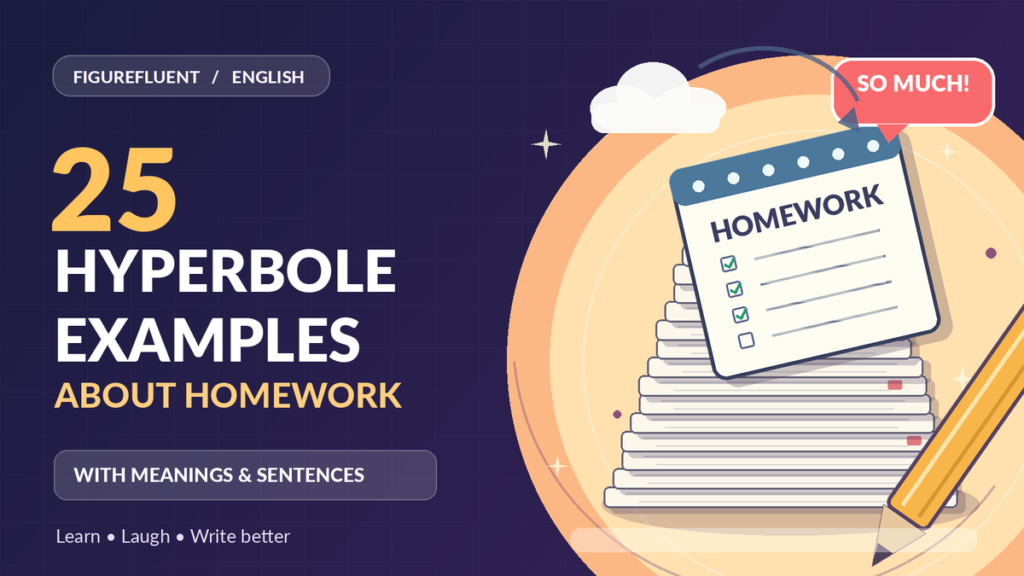
Imagine coming home from school, opening your backpack, and finding more worksheets than you expected. Your math assignment looks endless, your reading list keeps growing, and your notebook is already full.
You look at the pile of books and say, “I have enough homework to last a hundred years!”
Of course, you do not literally have a hundred years of homework. You are exaggerating to explain how much work you have.
That is an example of hyperbole.
Hyperbole examples about homework help students understand how writers use exaggeration to express strong feelings, create humor, and make ordinary school experiences more interesting.
Instead of simply writing, “I have a lot of homework,” a student might say, “My homework pile is taller than the school building.”
The second sentence creates a bigger, more memorable image.
In this guide, you will discover 25 hyperbole examples about homework, studying, school assignments, and examinations. Each example includes a simple meaning and an explanation of how the exaggeration works.
You will also learn how to identify hyperbole, create your own exaggerated sentences, and use this literary device naturally in creative writing.
What Is Hyperbole?
Hyperbole is a figure of speech that uses deliberate exaggeration for emphasis or effect.
The speaker or writer describes something as much bigger, smaller, longer, shorter, easier, or more difficult than it really is.
For example:
“I have told you a million times to finish your homework.”
The speaker probably has not repeated the instruction one million times.
The exaggeration communicates frustration or impatience.
Hyperbole is common in everyday English, stories, poems, conversations, advertisements, and humorous writing.
Some familiar hyperbole expressions include:
- “I’m so hungry I could eat a horse.”
- “I’ve been waiting forever.”
- “This bag weighs a ton.”
- “I have a million things to do.”
- “I could sleep for a week.”
These expressions are usually understood as exaggerations rather than literal statements.
Why Do Students Use Hyperbole About Homework?
Homework is a familiar part of school life, making it a useful subject for learning figurative language.
Students may exaggerate when describing:
- A large amount of homework
- Difficult mathematics problems
- Long reading assignments
- Preparing for an important examination
- Rewriting an essay several times
- Carrying heavy textbooks
- Feeling tired after studying
- Celebrating the end of an assignment
Hyperbole makes these experiences easier to describe in an expressive or humorous way.
However, good hyperbole should still communicate a clear idea.
The reader needs to understand what is being exaggerated and why.
25 Hyperbole Examples About Homework With Meanings
The following examples are organized into different homework situations, including heavy workloads, long study sessions, difficult assignments, and funny school experiences.
Each example explains the exaggeration and includes a sentence showing how it might appear in a story or conversation.
Hyperbole Examples About Too Much Homework
1. I Have a Mountain of Homework Tonight
Hyperbole: “I have a mountain of homework tonight.”
Meaning: The student has a large amount of homework.
Example sentence: “When I opened my school planner, I realized I had a mountain of homework waiting for me.”
Explanation:
Homework cannot literally form a mountain in this situation.
The expression exaggerates the amount of work by comparing it with something extremely large.
It is a familiar example of figurative language that can work as both a metaphor and an exaggeration.
Writing tip: Use this expression when a character feels overwhelmed by several assignments.
2. I Have a Million Questions to Answer
Hyperbole: “I have a million questions to answer.”
Meaning: The student has many questions to complete.
Example sentence: “My science worksheet looked simple until I turned the page and discovered a million questions waiting for answers.”
Explanation:
The worksheet probably contains a manageable number of questions.
The phrase “a million questions” exaggerates the quantity to show how large the task feels.
This is a straightforward example for students learning to recognize numerical hyperbole.
3. My Homework Stack Could Reach the Moon
Hyperbole: “My homework stack could reach the moon.”
Meaning: The student has a very large pile of assignments.
Example sentence: “By Friday afternoon, my unfinished worksheets had formed a stack that looked tall enough to reach the moon.”
Explanation:
A pile of school papers cannot realistically reach the moon.
The impossible height makes the statement an obvious exaggeration.
The expression creates a humorous image of an overwhelming workload.
4. There Are More Math Problems Than Stars in the Sky
Hyperbole: “There are more math problems than stars in the sky.”
Meaning: The student believes the worksheet contains too many mathematics questions.
Example sentence: “I stared at the exercise book and complained that there were more math problems than stars in the sky.”
Explanation:
The number of stars is enormous.
Comparing the worksheet’s questions with that number makes the homework seem almost endless.
This exaggeration emphasizes the student’s frustration.
5. These Worksheets Are Longer Than the Highway
Hyperbole: “These worksheets are longer than the highway.”
Meaning: The worksheets appear unusually long.
Example sentence: “Our teacher handed out the weekend assignments, and I joked that the worksheets were longer than the highway outside town.”
Explanation:
The papers are not actually longer than a highway.
The exaggerated comparison suggests that completing them will require significant effort.
This works well in a humorous classroom scene.
6. I Could Fill a Swimming Pool With My Study Notes
Hyperbole: “I could fill a swimming pool with my study notes.”
Meaning: The student has written a huge amount of information.
Example sentence: “After revising the entire history chapter, I felt as though I could fill a swimming pool with my study notes.”
Explanation:
A student’s notes would not realistically fill a swimming pool.
The exaggeration makes the quantity of writing seem enormous.
It also communicates how much time the student has spent preparing.
7. My Reading List Could Keep Me Busy for Ten Lifetimes
Hyperbole: “My reading list could keep me busy for ten lifetimes.”
Meaning: The reading assignment feels extremely long.
Example sentence: “When I saw the books assigned for our literature project, I said the reading list could keep me busy for ten lifetimes.”
Explanation:
The student does not literally need ten lifetimes to complete the reading.
The exaggerated time period communicates how demanding the assignment appears.
This sentence is useful for descriptions of reading-heavy school subjects.
Hyperbole Examples About Homework Taking Forever
8. I Spent a Century on One Math Problem
Hyperbole: “I spent a century on one math problem.”
Meaning: A single question took a long time to solve.
Example sentence: “I spent a century on one math problem before realizing I had copied the first number incorrectly.”
Explanation:
A century is one hundred years.
The student obviously did not spend that long on the question.
The exaggeration emphasizes the difficulty and frustration of solving it.
9. It Took Forever to Finish the First Page
Hyperbole: “It took forever to finish the first page.”
Meaning: Completing the first page seemed to take an unusually long time.
Example sentence: “The homework instructions were so confusing that it took forever to finish the first page.”
Explanation:
“Forever” means an unlimited amount of time.
In ordinary conversation, people often use it to describe something that feels slow or difficult.
Here, the word emphasizes the student’s impatience.
10. This Assignment Will Last Until Next Year
Hyperbole: “This assignment will last until next year.”
Meaning: The assignment seems very long or complicated.
Example sentence: “When I saw the number of tasks in the project, I joked that the assignment would last until next year.”
Explanation:
The student does not necessarily expect to work on the project for an entire year.
The statement exaggerates the expected duration to express concern about the workload.
It is particularly useful in informal dialogue.
11. I Have Read This Question a Hundred Times
Hyperbole: “I have read this question a hundred times.”
Meaning: The student has reread the question repeatedly but still finds it confusing.
Example sentence: “I have read this question a hundred times, and I still cannot understand what it wants me to calculate.”
Explanation:
The student may have read the question only several times.
The number one hundred is used to emphasize repeated effort.
This expression is common in everyday English.
12. I Have Rewritten This Paragraph a Thousand Times
Hyperbole: “I have rewritten this paragraph a thousand times.”
Meaning: The writer has revised the paragraph many times.
Example sentence: “I have rewritten this paragraph a thousand times, but the opening sentence still does not sound right.”
Explanation:
The statement exaggerates the number of revisions.
It communicates the student’s dissatisfaction and effort.
Writers can use this kind of hyperbole to show perfectionism or frustration.
13. The Clock Moves One Second Every Hour
Hyperbole: “The clock moves one second every hour.”
Meaning: Time seems to pass extremely slowly while the student is studying.
Example sentence: “During the longest homework session of the week, it felt as if the clock moved only one second every hour.”
Explanation:
The clock does not actually slow down.
The exaggeration describes the student’s experience of time.
This sentence can create a humorous or tired mood in a story.
14. I Will Still Be Doing Homework When I Am a Grandparent
Hyperbole: “I will still be doing homework when I am a grandparent.”
Meaning: The homework seems endless.
Example sentence: “Looking at the final ten questions, I announced that I would still be doing homework when I became a grandparent.”
Explanation:
The student does not expect the assignment to continue for decades.
The impossible time span makes the frustration amusing.
This kind of exaggeration works well in student conversations and humorous writing.
Funny Hyperbole Examples About Difficult Homework
15. My Brain Is About to Explode From These Equations
Hyperbole: “My brain is about to explode from these equations.”
Meaning: The student feels mentally overwhelmed.
Example sentence: “After struggling with the algebra worksheet, I closed my notebook and said my brain was about to explode.”
Explanation:
The expression is not meant literally.
It exaggerates how mentally demanding the homework feels.
Writers should use this kind of expression in appropriate informal or humorous contexts.
16. This Equation Is Harder Than Climbing Ten Mountains
Hyperbole: “This equation is harder than climbing ten mountains.”
Meaning: The student finds the mathematical problem extremely difficult.
Example sentence: “Solving the final equation felt harder than climbing ten mountains without a break.”
Explanation:
The equation does not literally require mountain climbing.
The comparison exaggerates the mental effort involved.
This example uses an exaggerated comparison to emphasize difficulty.
17. My Hand Is Going to Fall Off From Writing
Hyperbole: “My hand is going to fall off from writing.”
Meaning: The student’s hand feels tired after writing for a long time.
Example sentence: “After copying five pages of notes, I stretched my fingers and joked that my hand was going to fall off.”
Explanation:
The student’s hand is not actually going to fall off.
The exaggeration describes physical tiredness.
This is a common type of informal hyperbole that communicates discomfort through an impossible outcome.
18. My Backpack Weighs More Than an Elephant
Hyperbole: “My backpack weighs more than an elephant.”
Meaning: The backpack feels extremely heavy because of books and homework materials.
Example sentence: “With three textbooks and a folder full of worksheets, my backpack felt heavier than an elephant.”
Explanation:
An elephant weighs far more than a normal school backpack.
The exaggerated comparison emphasizes the weight of the school supplies.
It is an easy example for younger students because the difference is obvious.
19. I Need a Truck to Carry My Textbooks
Hyperbole: “I need a truck to carry my textbooks.”
Meaning: The student has many heavy books.
Example sentence: “When the teacher asked us to bring every textbook tomorrow, I joked that I would need a truck to carry them.”
Explanation:
A student would not normally need a truck for schoolbooks.
The statement exaggerates the amount or weight of the materials.
This example is suitable for funny school conversations.
20. I Have Used Enough Ink to Paint the Entire School
Hyperbole: “I have used enough ink to paint the entire school.”
Meaning: The student has written an enormous amount.
Example sentence: “After finishing the research report, I told my friend I had used enough ink to paint the entire school.”
Explanation:
The amount of ink used for homework would not cover a school building.
The exaggeration emphasizes the length of the writing task.
This example helps students practise creating unusual but understandable comparisons.
21. My Eraser Has Corrected a Million Mistakes
Hyperbole: “My eraser has corrected a million mistakes.”
Meaning: The student has made and corrected many errors.
Example sentence: “By the end of the mathematics lesson, my eraser had corrected a million mistakes.”
Explanation:
The student probably made far fewer than a million mistakes.
The number exaggerates the frequency of corrections.
The sentence also gives the eraser a role in the action, making the description more playful.
Hyperbole Examples About Finishing Homework
22. I Could Sleep for a Week After Finishing That Assignment
Hyperbole: “I could sleep for a week after finishing that assignment.”
Meaning: The student feels very tired.
Example sentence: “When I finally completed the science project, I dropped onto the sofa and said I could sleep for a week.”
Explanation:
The student does not literally plan to sleep for seven days.
The exaggerated amount of sleep communicates exhaustion.
This is a familiar form of hyperbole that can appear in casual conversations.
23. I Shouted “Finished!” Loud Enough for the Whole Town to Hear
Hyperbole: “I shouted ‘Finished!’ loud enough for the whole town to hear.”
Meaning: The student was extremely excited to complete the homework.
Example sentence: “After solving the final question, I shouted ‘Finished!’ so loudly that the whole town could have heard me.”
Explanation:
The student’s voice probably could not reach everyone in town.
The exaggeration emphasizes relief and excitement.
This sentence shows how hyperbole can communicate positive feelings, not only frustration.
24. My Homework Disappeared Faster Than Lightning
Hyperbole: “My homework disappeared faster than lightning.”
Meaning: The student completed the assignment surprisingly quickly.
Example sentence: “Once I understood the instructions, the remaining homework seemed to disappear faster than lightning.”
Explanation:
Lightning moves extremely quickly.
The exaggerated comparison emphasizes how fast the student finished the work.
This example shows that hyperbole can describe speed as well as quantity and time.
25. I Felt Like I Had Won a Million Trophies
Hyperbole: “I felt like I had won a million trophies.”
Meaning: The student felt extremely proud after completing a difficult assignment.
Example sentence: “When my teacher praised the project I had worked on all week, I felt like I had won a million trophies.”
Explanation:
The student has not literally received a million awards.
The exaggerated number communicates a powerful feeling of achievement.
This example is useful for positive endings in school stories.
Quick Table: 25 Homework Hyperbole Examples
The table below summarizes the examples and their intended meanings.
| Hyperbole Example | Simple Meaning |
|---|---|
| I have a mountain of homework. | A lot of homework |
| I have a million questions. | Many questions |
| My homework stack could reach the moon. | A huge pile of assignments |
| More problems than stars in the sky. | Too many math questions |
| Worksheets longer than the highway. | Very long worksheets |
| A swimming pool full of notes. | A large amount of writing |
| A reading list for ten lifetimes. | A very long reading assignment |
| I spent a century on one problem. | One problem took a long time |
| It took forever to finish. | The work felt slow |
| Homework will last until next year. | A lengthy assignment |
| I read the question a hundred times. | Repeated reading |
| I rewrote the paragraph a thousand times. | Many revisions |
| The clock moves one second every hour. | Time seems slow |
| Homework until I am a grandparent. | Work feels endless |
| My brain is about to explode. | Mental overload |
| Harder than climbing ten mountains. | A very difficult problem |
| My hand is going to fall off. | Tired from writing |
| My backpack weighs more than an elephant. | A heavy school bag |
| I need a truck for my textbooks. | Many heavy books |
| Enough ink to paint the school. | A lot of writing |
| My eraser corrected a million mistakes. | Many corrections |
| I could sleep for a week. | Extreme tiredness |
| The whole town heard me shout. | Great excitement |
| Homework disappeared faster than lightning. | Very quick completion |
| I felt like I won a million trophies. | Strong pride and happiness |
Hyperbole vs. Literal Language: Homework Examples
To understand hyperbole clearly, compare exaggerated sentences with ordinary statements.
Literal language describes something directly.
Hyperbole deliberately makes the description more extreme.
| Literal Sentence | Hyperbole Sentence |
|---|---|
| I have a lot of homework. | I have a mountain of homework. |
| This assignment takes a long time. | This assignment takes forever. |
| My backpack is heavy. | My backpack weighs a ton. |
| I have many questions. | I have a million questions. |
| This math problem is difficult. | This math problem is harder than climbing ten mountains. |
| I am tired after writing. | My hand is going to fall off. |
| I have made many mistakes. | My eraser has corrected a million mistakes. |
| I am happy to finish my homework. | I feel like I have won a million trophies. |
The exaggerated sentences communicate stronger feelings.
However, literal language is not automatically weaker.
In factual writing, homework instructions, academic reports, and precise explanations, direct language is often more suitable.
Hyperbole vs. Metaphor vs. Simile
Students sometimes confuse hyperbole with other figures of speech.
Although these literary devices can overlap, they serve different purposes.
Hyperbole
Hyperbole uses deliberate exaggeration.
Example: “I have a million homework questions.”
The number is greatly exaggerated.
Metaphor
A metaphor describes one thing as another to create a comparison.
Example: “My homework is a mountain.”
The homework is compared directly with a mountain.
Simile
A simile makes a comparison using like or as.
Example: “My homework pile is as tall as a mountain.”
The sentence uses as to compare the homework pile with a mountain.
It is also an exaggeration, so the sentence can contain both simile and hyperbole.
Personification
Personification gives human characteristics to something nonhuman.
Example: “My homework waited impatiently on the desk.”
The homework is described as if it can feel impatient.
For additional practice, use FigureFluent’s Figurative Language Checker to explore possible metaphors, similes, and personification in sentences.
You can also visit our Metaphor Meaning Explainer to learn how figurative comparisons communicate ideas.
How to Write Your Own Hyperbole About Homework
Creating hyperbole is easier when you begin with a familiar school situation.
Follow these steps to develop original exaggerated sentences.
Step 1: Choose a Real Homework Situation
Think about something you have experienced.
For example:
“I have several pages of mathematics homework.”
This is an ordinary statement.
Step 2: Identify the Main Feeling
Ask yourself how the situation makes you feel.
You might feel frustrated, tired, excited, impatient, or overwhelmed.
The emotion will guide your exaggeration.
Step 3: Exaggerate One Detail
Choose a detail that can be made much larger or more extreme.
For example:
“I have a million mathematics questions.”
The number is intentionally exaggerated.
Step 4: Make the Comparison Easy to Understand
An effective hyperbole sentence should communicate a clear idea.
For example:
“My homework pile is tall enough to touch the clouds.”
Readers understand that the sentence means there is a large amount of homework.
Step 5: Fit the Sentence to the Situation
Choose an exaggeration that matches your writing.
A funny school story may use playful comparisons.
A serious personal essay may need more restrained language.
Step 6: Read Your Sentence Again
Ask yourself three questions:
- Is the exaggeration intentional?
- Can readers understand the real meaning?
- Does the sentence improve the description?
If the answer to all three questions is yes, the hyperbole probably works well.
Hyperbole Examples for Different Grade Levels
Students can practise hyperbole at different levels of complexity.
Grades 3–5: Easy Hyperbole Examples
Younger students can begin with simple exaggerations.
- I have a million homework questions.
- My backpack weighs a ton.
- I waited forever for the bell.
- My homework pile reaches the clouds.
- I could sleep for a week.
These examples use familiar words and easy-to-understand situations.
Grades 6–8: More Descriptive Hyperbole
Middle school students can combine exaggeration with detail.
- My unfinished worksheets formed a tower tall enough to touch the classroom ceiling.
- The mathematics problem seemed to contain a thousand different steps.
- I had read the instructions so many times that I thought I could recite them in my sleep.
- My hand felt as if it had written every word in the dictionary.
- The last five minutes of homework seemed longer than the entire school day.
These examples provide a stronger sense of context.
Grades 9–12: Hyperbole With Mood and Voice
Older students can use exaggeration to reveal personality or emotion.
- The research project had swallowed every free minute of my week.
- Each unfinished question added another century to the evening.
- My history notes could have filled an entire library.
- The deadline seemed to race toward me at the speed of light.
- Finishing the final paragraph felt like winning the world’s greatest competition.
Some of these sentences combine hyperbole with other figures of speech.
Students should consider how the wording contributes to the narrator’s mood and voice.
Funny Hyperbole About Homework in Short Conversations
Hyperbole is common in informal conversations because people often exaggerate to express their feelings.
Conversation 1: Too Much Homework
Alex: “Are you coming to the park?”
Jamie: “I can’t. I have a mountain of homework.”
Alex: “That much?”
Jamie: “Enough to keep me busy until next year!”
Both of Jamie’s expressions exaggerate the workload.
Conversation 2: Difficult Mathematics
Mia: “How was the math assignment?”
Noah: “I spent a century on question five.”
Mia: “Did you solve it?”
Noah: “Eventually. I had copied the question incorrectly!”
The exaggerated time period creates humor.
Conversation 3: Finishing a Project
Emma: “I finally finished my science report!”
Olivia: “You look happy.”
Emma: “Happy? I feel like I’ve won a million trophies!”
The exaggeration communicates excitement.
Conversation 4: Heavy Textbooks
Daniel: “Why are you walking so slowly?”
Leo: “My backpack weighs more than an elephant.”
Daniel: “Did you bring every book you own?”
Leo: “Almost!”
The hyperbole makes the situation more playful.
Conversation 5: Essay Revisions
Teacher: “How is your essay coming along?”
Student: “I’ve rewritten the opening paragraph a thousand times.”
Teacher: “Sometimes a simple beginning is best.”
This example exaggerates the number of revisions.
Homework Hyperbole Practice Worksheet
Read each sentence and decide whether it contains hyperbole.
| Sentence | Hyperbole? |
|---|---|
| 1. I have ten math questions to complete. | Yes / No |
| 2. My homework pile reaches the moon. | Yes / No |
| 3. I spent forever writing my essay. | Yes / No |
| 4. My pencil is on the table. | Yes / No |
| 5. I could sleep for a hundred years. | Yes / No |
| 6. The textbook contains twelve chapters. | Yes / No |
| 7. My backpack weighs a thousand tons. | Yes / No |
| 8. I finished my homework after dinner. | Yes / No |
| 9. I have read this question a million times. | Yes / No |
| 10. My notebook has eighty pages. | Yes / No |
Answer Key
1. No. The sentence gives a realistic number of questions.
2. Yes. A homework pile cannot literally reach the moon.
3. Yes. “Forever” exaggerates the amount of time spent writing.
4. No. This is a literal statement about an object’s location.
5. Yes. Sleeping for a hundred years is an extreme exaggeration.
6. No. The statement describes a possible number of textbook chapters.
7. Yes. A school backpack cannot realistically weigh a thousand tons.
8. No. The sentence describes a normal event.
9. Yes. The student exaggerates how many times the question was read.
10. No. Eighty pages is a realistic notebook length.
Teachers can create additional figurative language activities with FigureFluent’s Figurative Language Worksheet Generator.
Students can also practise recognizing supported literary devices with our Figurative Language Quiz.
Five Creative Writing Activities Using Homework Hyperbole
Activity 1: Rewrite a Boring Sentence
Start with this sentence:
“I have a lot of homework.”
Write three different exaggerated versions.
Possible answers:
- My homework pile is taller than the school.
- I have enough questions to fill a thousand notebooks.
- My reading assignment will take ten lifetimes.
Compare the sentences and decide which communicates the strongest feeling.
Activity 2: Write a Funny Homework Conversation
Imagine two friends discussing their school assignments.
Write a conversation containing at least three examples of hyperbole.
Make sure each exaggeration fits what the characters are discussing.
Activity 3: Describe an Endless Study Session
Write a short paragraph about a student studying late in the evening.
Use one exaggeration about time and another about tiredness.
For example:
“The clock seemed to move one second every hour. By the time I finished the final question, I felt as though I could sleep for a week.”
Activity 4: Turn Literal Sentences Into Hyperbole
Rewrite the following sentences:
- My textbook is very heavy.
- This assignment is difficult.
- I have written many pages.
- I am tired after studying.
- I am happy that my homework is complete.
Try to create exaggerations without using the exact examples from this guide.
Activity 5: Create a Hyperbole Comic Strip
Draw a short comic about a student who receives a large homework assignment.
Include exaggerated expressions in speech bubbles.
For example:
“My homework stack is taller than a skyscraper!”
The drawings can emphasize the exaggeration and make its meaning easier to understand.
Common Mistakes When Writing Hyperbole
1. Using an Exaggeration That Could Be Literally True
Consider this sentence:
“I have twenty homework questions.”
The statement is not necessarily hyperbole because a worksheet might genuinely contain twenty questions.
Now compare:
“I have a million homework questions.”
The enormous number makes the exaggeration clear.
2. Confusing Hyperbole With Ordinary Comparison
Not every comparison is exaggerated.
For example:
“My bag is heavier than my friend’s bag.”
This could be literally true.
“My bag is heavier than an elephant.”
This is an obvious exaggeration.
3. Adding Too Many Exaggerations
A paragraph filled with hyperbole can become confusing.
Consider:
“My homework weighed a million tons, took a thousand years, and made my pencil fly to the moon.”
The exaggerations compete for attention.
A clearer version might be:
“My homework pile looked tall enough to reach the moon.”
One strong image may communicate the idea more effectively.
4. Forgetting the Real Meaning
Hyperbole should exaggerate something understandable.
If readers cannot identify what is being exaggerated, the sentence may not communicate the intended idea.
Choose an image that connects naturally with the situation.
5. Using Hyperbole in Formal Factual Writing
Hyperbole is useful in stories, jokes, poems, and informal conversations.
However, academic reports and factual explanations usually require precise language.
For example, a science report should describe actual measurements rather than exaggerated ones.
6. Repeating Familiar Expressions Too Often
Expressions such as “a million times” and “forever” are common.
They can be effective, but original exaggerations may make creative writing more memorable.
Instead of always saying “I waited forever,” try describing the situation more specifically.
For example:
“The final ten minutes of homework felt longer than the entire weekend.”
Frequently Asked Questions About Homework Hyperbole
What are some examples of hyperbole about homework?
Examples include “I have a mountain of homework,” “My homework stack could reach the moon,” and “I spent a century on one math problem.” Each uses deliberate exaggeration to describe a school experience.
What is a funny hyperbole sentence about homework?
“I will still be doing this homework when I become a grandparent” is a funny example. It exaggerates how long the assignment seems to take.
Is “I have a ton of homework” hyperbole?
Yes. In ordinary conversation, the expression exaggerates the quantity of homework. It does not mean the student has a literal ton of assignments.
What is a good hyperbole example for students?
“My backpack weighs more than an elephant” is a clear example. It exaggerates the bag’s weight in an easy-to-understand way.
What is hyperbole in simple English?
Hyperbole means using a big exaggeration to emphasize an idea or feeling. It is not intended to be understood literally.
How do you write hyperbole about studying?
Begin with a real study experience, identify the strongest feeling, and exaggerate one detail. For example, “I studied for a long time” could become “I studied for a hundred years.”
Can hyperbole be used in school essays?
Yes, particularly in creative writing, personal narratives, and humorous essays. Formal academic writing usually requires more direct language.
Is “homework is a mountain” a metaphor or hyperbole?
It can be both. The sentence directly compares homework with a mountain, making it a metaphor. It can also exaggerate the amount of homework, making it hyperbolic.
What is the difference between hyperbole and a simile?
Hyperbole uses deliberate exaggeration. A simile compares two things using like or as. A sentence can use both techniques.
Is “this homework takes forever” hyperbole?
Yes. The word “forever” exaggerates the time required to complete the work.
Why do writers use hyperbole?
Writers use hyperbole to emphasize emotions, create humor, add personality, and make descriptions more memorable.
Can hyperbole express positive feelings?
Yes. For example, “I felt like I had won a million trophies” exaggerates the excitement of completing a difficult assignment.
Does hyperbole have to be funny?
No. Hyperbole can create humor, but it can also express frustration, excitement, surprise, exhaustion, or other strong feelings.
Final Thoughts
Hyperbole helps writers describe familiar experiences in imaginative and expressive ways.
Homework provides many opportunities for exaggeration because students often encounter long assignments, challenging questions, heavy textbooks, and demanding study sessions.
A student might describe a large workload as a mountain of homework, claim that one question took a century, or announce that finishing an assignment feels like winning a million trophies.
None of these statements is meant literally.
Their purpose is to communicate feelings through exaggerated images.
The best hyperbole examples are clear, relevant, and connected to the situation.
When writing your own examples, start with a real school experience and exaggerate one meaningful detail.
Use humor when it fits your story, but remember that exaggeration can also express determination, pride, and relief.
With regular practice, you can become more confident recognizing hyperbole and using it naturally in creative writing.
For more figurative language examples, free writing tools, and educational activities, explore FigureFluent.
You can also discover related school comparisons in our guides to Metaphors for Exam Stress and Similes for Exam Stress.
Leave a Reply