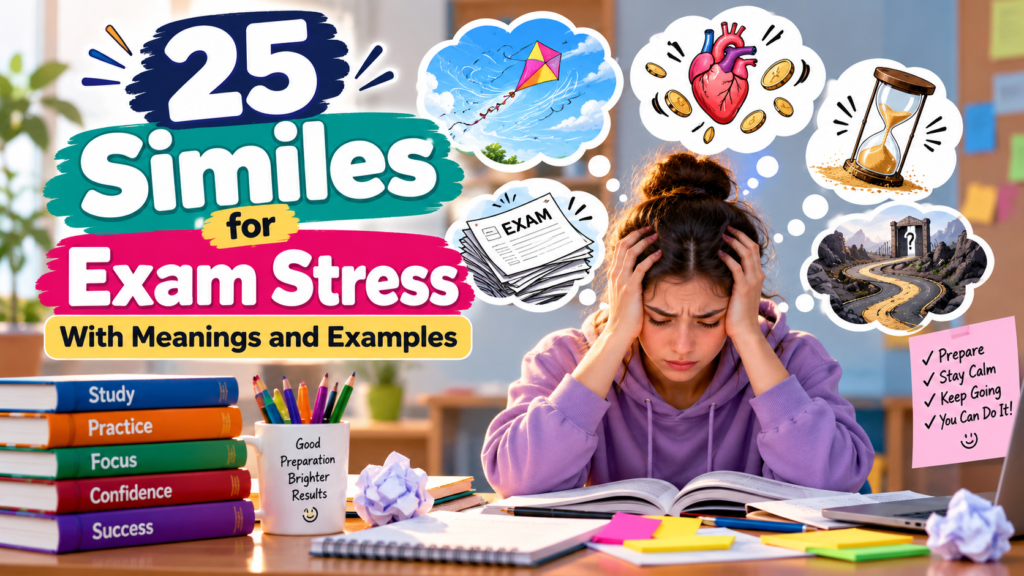
Exams can make even a familiar classroom feel different. Your hands may become shaky, your thoughts may race, and the few minutes before a test can seem much longer than usual. These feelings are sometimes difficult to describe with ordinary words.
Similes for exam stress offer a creative way to explain nervousness, pressure, uncertainty, and relief. By comparing exam experiences with familiar objects and situations, writers can help readers understand exactly how a student feels.
For example, instead of writing, “I was nervous before my exam,” you could write:
“My heartbeat rattled like loose change in a pocket.”
This comparison creates a picture of a quick, unsettled heartbeat and helps the reader imagine the student’s nervousness.
In this guide, you will discover 25 similes for exam stress and nervousness, complete with meanings, sentence examples, writing tips, and practical exercises. These examples are useful for students, teachers, English learners, and anyone who wants to make descriptive writing more expressive.
What Is a Simile for Exam Stress?
A simile is a figure of speech that compares two different things using words such as like or as.
The comparison highlights a quality that the two things share.
For example:
“My hands were as shaky as leaves in the wind.”
The writer compares trembling hands with leaves moving in the wind. The comparison helps the reader picture the physical feeling of nervousness.
Similes can make writing more specific, imaginative, and memorable.
When describing examinations, students can use similes to express:
- Nervousness before entering the classroom
- Fear of unfamiliar questions
- Difficulty concentrating
- Pressure caused by time limits
- Uncertainty about remembering answers
- Confidence gained through preparation
- Relief after finishing a difficult test
A well-chosen simile makes an emotion easier to imagine without needing a long explanation.
25 Similes for Exam Stress and Nervousness
The following original similes describe feelings before, during, and after examinations.
Each comparison includes its meaning and an example showing how it can fit naturally into a sentence.
Similes for Feeling Nervous Before an Exam
1. My Stomach Fluttered Like a Paper Kite in the Wind
Meaning: This simile describes the uncomfortable, fluttering feeling that nervousness can create.
Example: “As I walked toward the examination hall, my stomach fluttered like a paper kite caught in a sudden gust of wind.”
A paper kite moves unpredictably when the wind changes.
Comparing that movement with a nervous stomach suggests a feeling that is difficult to control.
This simile is particularly useful in personal narratives about waiting for an important event.
2. My Thoughts Jumped Like Sparrows Leaving a Fence
Meaning: Nervous thoughts can move quickly from one subject to another.
Example: “The teacher handed out the test papers, and my thoughts jumped like sparrows leaving a fence.”
Sparrows can move suddenly and in different directions.
The comparison suggests that the student is struggling to keep one clear thought in mind.
Writers can use this simile when describing distraction or difficulty concentrating before an examination.
3. My Heart Rattled Like Loose Coins in a Pocket
Meaning: This simile communicates a rapid, unsettled heartbeat caused by nervousness.
Example: “When I heard my name called for the oral examination, my heart rattled like loose coins in a pocket.”
Loose coins make a repeated rattling sound when someone moves.
The comparison creates a vivid impression of nervous excitement or fear.
It works well in stories about presentations, interviews, examinations, and other situations involving pressure.
4. The Night Before the Exam Stretched Like an Endless Road
Meaning: Time may seem to pass slowly when someone is worried about an upcoming examination.
Example: “The night before my final science exam stretched like an endless road, and I kept checking the clock.”
A long road suggests distance and a journey that seems to continue without ending.
In this simile, the writer uses that image to describe the experience of waiting.
It is especially useful when writing about anticipation and uncertainty.
5. I Held My Notes Like a Sailor Holding a Rail in Rough Weather
Meaning: A student may depend heavily on revision materials when feeling uncertain.
Example: “Outside the examination room, I held my revision notes like a sailor gripping a rail in rough weather.”
The sailor holds the rail for stability.
Similarly, the student holds the notes because they provide a sense of security.
This comparison can communicate both nervousness and the desire to feel prepared.
6. Doubt Entered My Mind Like Cold Air Through a Small Crack
Meaning: Even a small worry can gradually affect a student’s confidence.
Example: “I had studied for several days, but doubt entered my mind like cold air through a small crack.”
Cold air entering a room through a narrow opening may seem insignificant at first but gradually becomes noticeable.
The comparison suggests how one uncertain thought can lead to additional worries.
7. My Confidence Wobbled Like a Table With One Short Leg
Meaning: Confidence can feel unstable when a student begins questioning their preparation.
Example: “I knew most of the material, yet my confidence wobbled like a table with one short leg.”
A table with uneven legs may remain standing but cannot feel completely steady.
This simile shows that the student has some confidence, although nervous thoughts are making it less reliable.
8. Waiting for the Exam Felt As Slow As a Queue That Never Moved
Meaning: Anticipation can make a short period feel unusually long.
Example: “The final ten minutes before the examination felt as slow as a queue that never moved.”
Waiting in a stationary queue can feel frustrating because no progress is visible.
This simile describes the uncomfortable experience of waiting for something important to begin.
Similes for Stress During an Examination
9. The Questions Crowded Together Like Passengers on a Busy Bus
Meaning: A question paper may feel overwhelming when it contains many demanding tasks.
Example: “As soon as I opened the paper, the questions crowded together like passengers on a busy bus.”
A crowded bus creates an impression of limited space and competing demands.
The comparison helps describe the feeling of facing several questions that all require attention.
10. My Pen Hovered Like a Bird Afraid to Land
Meaning: A student may hesitate before writing because they are unsure about the answer.
Example: “I understood part of the question, but my pen hovered like a bird afraid to land.”
A bird circling above the ground may appear reluctant to settle.
Similarly, the student’s pen remains above the paper while they decide what to write.
This simile is useful for describing hesitation without simply saying, “I was confused.”
11. My Hands Shook Like Leaves in a Gentle Wind
Meaning: Nervousness can make a person’s hands tremble.
Example: “When I began the practical examination, my hands shook like leaves in a gentle wind.”
Leaves move slightly when air passes through them.
The comparison gives the reader a clear picture of trembling hands.
It is a simple simile that younger students can understand and use in their writing.
12. The Classroom Was As Quiet As a Library Before Closing
Meaning: The examination room was unusually silent.
Example: “When the examination started, the classroom became as quiet as a library before closing.”
A library is commonly associated with a calm environment where people avoid making noise.
The comparison emphasizes silence and can help establish the atmosphere of the examination room.
To develop the description, a writer could mention the faint sound of pages turning or pens moving across paper.
13. The Minutes Slipped Away Like Sand Through Open Fingers
Meaning: Time can pass quickly when someone is trying to finish an examination.
Example: “I had three questions left, but the minutes slipped away like sand through my open fingers.”
Sand falls easily through spaces between fingers and is difficult to hold.
The comparison suggests that the student cannot stop time from passing.
This simile is useful for describing time pressure.
14. The Instructions Twisted Like a Road Through Unfamiliar Streets
Meaning: Complicated instructions may feel difficult to follow.
Example: “The instructions twisted like a road through unfamiliar streets, and I had to read them twice.”
An unfamiliar road with several turns can make navigation confusing.
The simile communicates how a student may struggle to identify what a question is asking.
It also suggests that careful reading may help the student find the correct direction.
15. My Concentration Broke Like a Soap Bubble
Meaning: A sudden distraction can interrupt a student’s focus.
Example: “Just as I remembered the answer, someone dropped a pencil, and my concentration broke like a soap bubble.”
Soap bubbles are delicate and can burst with very little contact.
The comparison suggests that concentration was present but easily interrupted.
This simile works well in descriptive writing about distractions in a quiet environment.
16. My Breathing Came in Short Bursts Like a Runner After a Sprint
Meaning: This simile describes the physical sensation of being very nervous.
Example: “Before I answered the first question, my breathing came in short bursts like a runner after a sprint.”
A runner may breathe rapidly after intense physical activity.
The student is not necessarily running, but the comparison communicates a similar sense of physical tension.
Use this simile when describing a particularly stressful moment rather than ordinary mild nervousness.
17. The Final Question Looked Like a Locked Gate
Meaning: A difficult question can seem like an obstacle with no obvious solution.
Example: “The final chemistry question looked like a locked gate, and I searched my memory for something that might open it.”
A locked gate prevents someone from moving forward until they find a way through.
The comparison suggests that the student needs knowledge or a new approach to solve the problem.
18. My Answer Appeared Like a Photograph Slowly Coming Into Focus
Meaning: Understanding may develop gradually after a period of confusion.
Example: “After reading the question again, my answer appeared like a photograph slowly coming into focus.”
An unclear photograph becomes easier to understand as the image sharpens.
This simile describes the moment when a difficult idea begins to make sense.
It can also create a positive change in a paragraph that begins with nervousness.
19. My Mind Went Blank Like a Whiteboard Wiped Clean
Meaning: The student temporarily struggled to remember information.
Example: “I had revised the formulas all week, but when I saw the question, my mind went blank like a whiteboard wiped clean.”
A clean whiteboard contains no visible writing.
The comparison expresses the feeling of suddenly being unable to recall something familiar.
It is especially appropriate for stories about tests, presentations, and public speaking.
20. The Clock Ticked Like Someone Tapping on a Window
Meaning: The sound of a clock can become distracting when time is limited.
Example: “While I worked through the final questions, the clock ticked like someone tapping repeatedly on a window.”
Repeated tapping can draw attention away from another task.
The comparison suggests that the student has become unusually aware of each passing second.
This simile creates a sense of pressure through sound.
Similes for Waiting for Results and Feeling Relief
21. Relief Came Over Me Like Cool Water on a Hot Afternoon
Meaning: Finishing an examination can bring a sudden feeling of comfort.
Example: “When I handed in my answer sheet, relief came over me like cool water on a hot afternoon.”
Cool water provides comfort when someone feels overheated.
The simile compares that refreshing feeling with the emotional relief of completing a stressful task.
It can create a satisfying ending to an exam-related story.
22. My Shoulders Relaxed Like a Spring Finally Released
Meaning: A student may feel less physically tense after finishing an examination.
Example: “As I walked out of the examination hall, my shoulders relaxed like a spring finally released.”
A compressed spring stores tension until it is released.
The comparison suggests that the student’s body had been tense during the examination and is now relaxing.
23. Waiting for My Results Felt Like Watching Dark Clouds Gather
Meaning: Uncertainty about exam results can create nervous anticipation.
Example: “Waiting for my results felt like watching dark clouds gather without knowing whether the rain would arrive.”
Dark clouds suggest the possibility of a storm, but the outcome is not always certain.
Similarly, a student may worry about the result without knowing what will happen.
The simile emphasizes uncertainty rather than the result itself.
24. My Hope Returned Like Sunshine After Several Grey Days
Meaning: Confidence and optimism can return after a difficult period.
Example: “When I remembered the answers I had written correctly, my hope returned like sunshine after several grey days.”
Sunshine after cloudy weather creates a sense of brightness and change.
The comparison expresses renewed optimism following an anxious experience.
25. Walking Home Felt As Easy As Taking Off Heavy Boots
Meaning: Completing an important examination may make a student feel free from a burden.
Example: “After weeks of revision and a demanding final test, walking home felt as easy as taking off heavy boots.”
Removing heavy boots after a long journey can create physical comfort.
The comparison communicates the feeling of moving beyond a tiring experience.
It is particularly useful for ending a personal narrative about examination preparation.
Quick Table: Exam Stress Similes and Their Meanings
The table below summarizes several similes and the feelings they express.
| Simile | Meaning | Feeling |
|---|---|---|
| Like a paper kite in the wind | Feeling physically unsettled | Nervousness |
| Like loose coins in a pocket | A rapid heartbeat | Anxiety |
| Like a table with one short leg | Unsteady confidence | Uncertainty |
| Like passengers on a busy bus | Too many demands at once | Pressure |
| Like sand through open fingers | Time passing quickly | Urgency |
| Like a soap bubble | Easily interrupted focus | Distraction |
| Like a whiteboard wiped clean | Difficulty remembering | Confusion |
| Like a photograph coming into focus | Gradual understanding | Clarity |
| Like cool water on a hot afternoon | Comfort after pressure | Relief |
| Like sunshine after grey days | Confidence returning | Hope |
These comparisons can help you choose a simile that matches the emotion you want to describe.
Similes vs. Metaphors for Exam Stress
Similes and metaphors both compare things, but their sentence structures are usually different.
A simile makes a comparison using words such as like or as.
A metaphor makes a direct comparison by describing one thing as another.
For example:
| Simile | Metaphor |
|---|---|
| The test was like a mountain. | The test was a mountain. |
| My mind was like a crowded highway. | My mind was a crowded highway. |
| The question looked like a locked gate. | The question was a locked gate. |
| The room felt like a pressure cooker. | The room was a pressure cooker. |
| My memory was like a blank whiteboard. | My memory was a blank whiteboard. |
Neither type is automatically better.
A simile can make a comparison easier to recognize, while a metaphor may give the comparison a stronger or more direct tone.
For more examples, read our related guide: 25 Metaphors for Exam Stress With Meanings and Examples.
You can also practise comparisons with our free Metaphor to Simile Converter.
How to Write Your Own Similes About Exam Stress
Creating original similes is easier when you begin with a specific feeling rather than choosing a random comparison.
Step 1: Identify the Emotion
Think about what you want the reader to understand.
For example:
“I felt nervous before the exam.”
Ask yourself what nervousness felt like.
Did your hands shake? Did your thoughts move quickly? Did time seem to slow down?
Specific details make comparisons more meaningful.
Step 2: Choose a Familiar Image
Find an object or situation with a similar quality.
For shaky hands, you might think about leaves moving in the wind.
For racing thoughts, you might imagine birds suddenly flying in different directions.
Choose an image that a reader can picture easily.
Step 3: Add Like or As
Turn the comparison into a simile.
Plain sentence:
“My thoughts were moving quickly.”
Simile:
“My thoughts moved like sparrows startled from a fence.”
The second sentence gives the reader a more specific image.
Step 4: Add Context
A simile is often more effective when it appears in a complete sentence.
For example:
“As the teacher opened the examination papers, my thoughts moved like sparrows startled from a fence.”
The additional context helps the reader understand why the student feels nervous.
Step 5: Check the Comparison
Before using your simile in an assignment, ask yourself:
- Does the image match my intended feeling?
- Will readers understand the comparison?
- Does the simile sound natural in the sentence?
- Have I used too many comparisons in one paragraph?
A simple, clear simile is usually better than a complicated image that makes the meaning difficult to understand.
How to Use Exam Stress Similes in Descriptive Writing
Similes can improve personal narratives, descriptive essays, journal entries, and creative writing assignments.
Consider this plain paragraph:
“I was nervous during the exam. The questions were difficult, and I was worried because there was not much time left. I felt better when the test ended.”
The paragraph communicates the basic experience, but it offers few descriptive details.
Here is a revised version:
“My hands shook like leaves in a gentle wind as I opened the examination paper. The questions crowded together like passengers on a busy bus, and the final minutes slipped away like sand through my open fingers. When I finally handed in my answers, relief came over me like cool water on a hot afternoon.”
The revised paragraph describes nervousness, pressure, and relief through familiar images.
However, too many similes can make writing feel crowded.
You do not need a comparison in every sentence. Combining occasional similes with actions, sensory details, and ordinary description often produces more natural writing.
For more practice, visit our Show, Don’t Tell Writing Tool.
Common Mistakes to Avoid When Writing Similes
1. Making Comparisons That Do Not Match
A comparison should highlight a meaningful shared quality.
For example:
“My exam was like a blue umbrella.”
This sentence does not communicate much unless the writer explains a meaningful connection.
A clearer comparison might be:
“My exam felt like a puzzle with several missing pieces.”
2. Using Too Many Similes
Several unrelated comparisons in one sentence may confuse the reader.
Instead of:
“My mind was like a bus, my thoughts were like clouds, and my nerves were like a waterfall.”
Choose one comparison that describes the most important feeling.
3. Repeating Familiar Images Without Adding Detail
Common expressions such as “as nervous as a cat” can communicate a feeling, but original details often make writing more memorable.
Consider the situation and choose imagery that reflects your specific experience.
4. Confusing Similes With Metaphors
Remember:
Simile: “My thoughts moved like restless birds.”
Metaphor: “My thoughts were restless birds.”
Both are figurative comparisons, but their structures are different.
Also, not every sentence containing like is a simile. The word must actually create a meaningful comparison.
5. Forgetting the Purpose of the Comparison
The goal is to help readers understand an emotion or experience.
If a simile makes the sentence harder to understand, revise it or use a direct description instead.
Practice Activity: Write Your Own Exam Stress Similes
Try completing these sentences using your own comparisons.
Exercise 1: Before entering the examination room, my heartbeat sounded like __________.
Exercise 2: The difficult question looked like __________.
Exercise 3: The final five minutes passed as quickly as __________.
Exercise 4: My nervous hands shook like __________.
Exercise 5: When the exam ended, I felt as relieved as __________.
Sample Answers
- My heartbeat sounded like a drum being played too quickly.
- The difficult question looked like a puzzle missing its most important piece.
- The final five minutes passed as quickly as a train rushing past a station.
- My nervous hands shook like branches in a sudden breeze.
- When the exam ended, I felt as relieved as a traveler reaching home after a long journey.
These are examples, not the only correct answers.
You can create many different similes if the comparison communicates the intended idea clearly.
To practise identifying figurative language, try FigureFluent’s Figurative Language Quiz.
Teachers can also prepare printable activities using the Figurative Language Worksheet Generator.
Frequently Asked Questions About Similes for Exam Stress
What is a good simile for exam stress?
“My thoughts jumped like sparrows leaving a fence” is a useful simile for exam stress. It describes how nervous thoughts can move quickly and become difficult to control.
What is a simile for feeling nervous before a test?
“My heart rattled like loose coins in a pocket” describes a nervous heartbeat. The comparison helps readers imagine the physical sensation of nervousness.
What is a simile for test anxiety?
“My confidence wobbled like a table with one short leg” can describe uncertainty before a test. It suggests that the student has some confidence but is struggling to feel steady.
How can I describe shaking hands using a simile?
You could write, “My hands shook like leaves in a gentle wind.” This creates an easy-to-understand image of trembling hands.
What is a simile for running out of time during an exam?
“The minutes slipped away like sand through open fingers” describes how quickly time can seem to pass during a demanding examination.
Can I use similes in a school essay?
Yes. Similes can make descriptive writing and personal narratives more expressive. Choose comparisons that fit the assignment, communicate a clear idea, and sound natural in context.
What is the difference between a simile and a metaphor?
A simile generally uses like or as to make a comparison, while a metaphor describes one thing directly as another.
For example, “The exam was like a mountain” is a simile. “The exam was a mountain” is a metaphor.
How many similes should I use in a paragraph?
There is no fixed rule. One or two carefully chosen comparisons may be enough for a short descriptive paragraph. The aim is clarity, not adding as many similes as possible.
Can similes describe relief after an examination?
Yes. For example, “Relief came over me like cool water on a hot afternoon” describes the comforting feeling of finishing a stressful task.
Final Thoughts
Similes for exam stress and nervousness can turn simple statements into more expressive descriptions.
A nervous heartbeat can rattle like loose coins, a difficult question can resemble a locked gate, and the final minutes of an examination can slip away like sand through open fingers.
These comparisons help readers understand emotions through familiar images.
When writing about exams, choose similes that match your actual experience. You do not need complicated language to make a strong impression. A clear comparison with a meaningful detail is often enough.
Whether you are preparing a classroom assignment, writing a personal story, or improving your creative writing skills, practising similes can help you communicate your ideas more effectively.
Explore more free examples, worksheets, quizzes, and interactive learning activities at FigureFluent, where learning figurative language becomes a practical part of everyday writing.
Leave a Reply