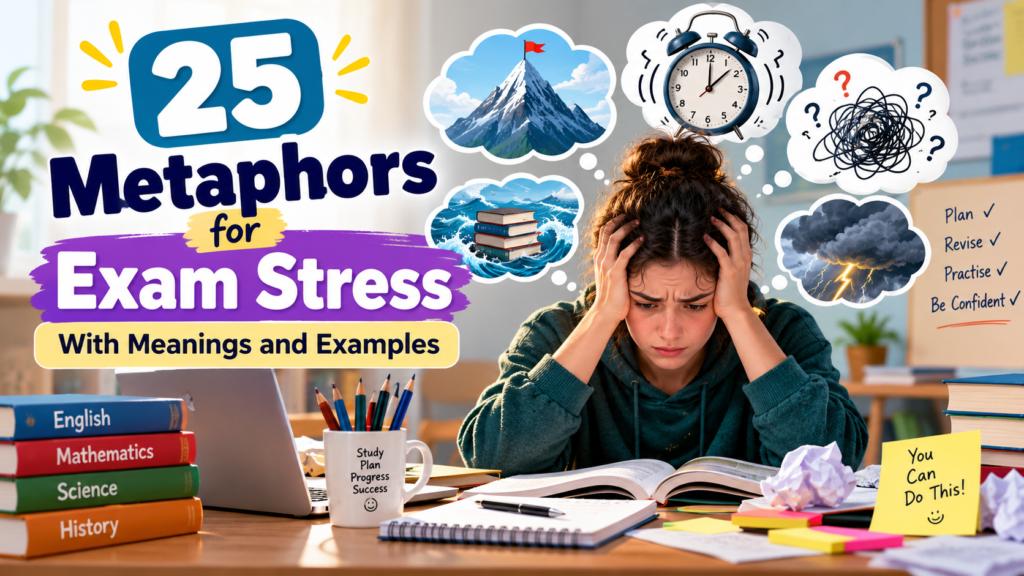
Exam stress can turn an ordinary school day into something that feels overwhelming. A ticking clock, a difficult question, or a long list of topics to revise can make even a well-prepared student feel nervous. But how can we describe those feelings in a more creative way?
Metaphors for exam stress help us explain pressure, nervousness, uncertainty, and determination through imaginative comparisons. Instead of simply saying “I was worried about my test,” a writer might say, “The exam was a mountain standing in my path.”
That sentence creates a picture of a difficult challenge without saying that the exam is literally a mountain.
In this guide, you will discover 25 metaphors about exams and test anxiety, along with their meanings and sentence examples. You will also learn how to create your own metaphors for school assignments, personal writing, and descriptive essays.
What Is a Metaphor for Exam Stress?
A metaphor is a figure of speech that describes one thing as another to communicate an idea or feeling.
For example:
“The examination room was a pressure cooker.”
An examination room is not actually a cooking appliance. The metaphor suggests that the room feels intensely stressful, with students experiencing pressure as they work.
Metaphors help readers imagine emotions and situations rather than simply being told about them.
Students often use exam stress metaphors to describe:
- Fear before an important test
- Pressure to achieve high grades
- Difficulty remembering information
- Nervousness during examinations
- The challenge of revising a large syllabus
- Confidence and determination
- Relief after an examination ends
These comparisons can make a personal narrative, poem, journal entry, or descriptive paragraph more expressive.
25 Metaphors for Exam Stress With Meanings and Examples
The following original examples explore different experiences before, during, and after examinations.
1. The Exam Was a Mountain to Climb
Meaning: An exam can feel like a huge challenge that requires preparation, patience, and determination.
Example: “The final mathematics exam was a mountain to climb, but every revision session brought me closer to the summit.”
A mountain represents something difficult but achievable. The image of climbing also suggests gradual improvement.
This metaphor works especially well when writing about determination or overcoming challenges at school.
2. The Clock Was a Relentless Drummer
Meaning: Time can seem unusually loud and distracting during a stressful examination.
Example: “The classroom clock was a relentless drummer, beating faster in my thoughts as the minutes disappeared.”
The clock is compared to a drummer because its repeated ticking creates a sense of urgency.
Writers can use this metaphor when describing the pressure of completing questions before time runs out.
3. My Mind Was a Crowded Highway
Meaning: Too many thoughts, worries, and pieces of information can compete for attention.
Example: “Minutes before the science test, my mind was a crowded highway filled with formulas, doubts, and unfinished thoughts.”
A busy highway suggests constant movement and congestion.
The comparison helps readers picture how difficult it can feel to concentrate when several thoughts arrive at once.
4. The Question Paper Was a Maze
Meaning: Questions may feel confusing, complicated, or difficult to navigate.
Example: “The question paper was a maze, and every unfamiliar problem seemed to lead me toward another dead end.”
A maze represents uncertainty and the challenge of finding a clear path.
This metaphor is useful for describing a difficult examination without claiming that every question is impossible.
5. My Revision Notes Were an Ocean of Information
Meaning: The amount of material to study may feel enormous.
Example: “My revision notes were an ocean of information, and I struggled to decide where to begin.”
An ocean suggests great size and depth.
This metaphor can make a paragraph about exam preparation more vivid, particularly when describing a large syllabus.
6. The Deadline Was an Approaching Storm
Meaning: An approaching exam date can create a growing sense of pressure.
Example: “The deadline was an approaching storm, gathering strength with every day I spent delaying my revision.”
A storm creates an image of something powerful moving closer.
Writers can use the comparison to describe increasing tension as an examination date approaches.
7. My Memory Was a Locked Filing Cabinet
Meaning: Information may seem stored in the mind but difficult to retrieve under pressure.
Example: “During the history exam, my memory was a locked filing cabinet, and I could not find the key to the dates I had revised.”
A filing cabinet normally stores organized information. A locked cabinet suggests that the information is temporarily inaccessible.
The metaphor is especially effective in stories about forgetting something during a test.
8. The Blank Answer Sheet Was a Silent Wall
Meaning: Beginning an answer can feel difficult when a student is unsure what to write.
Example: “The blank answer sheet was a silent wall standing between my thoughts and the words I needed.”
A wall represents an obstacle.
This metaphor describes the uncomfortable moment when a student understands the question but struggles to begin writing.
9. Worry Was a Backpack Full of Stones
Meaning: Stress can feel like an emotional burden that becomes heavier over time.
Example: “Every thought about my grades added another stone to the backpack of worry I carried into the classroom.”
A backpack full of stones suggests weight and exhaustion.
The image helps a reader understand how repeated concerns can become difficult to manage.
10. The Examination Hall Was a Pressure Cooker
Meaning: The examination environment may feel tense and demanding.
Example: “The examination hall was a pressure cooker, filled with nervous silence and the rapid scratching of pens.”
A pressure cooker builds pressure inside a closed space.
In descriptive writing, this metaphor can communicate the atmosphere of an important test through a familiar object.
11. My Doubts Were a Swarm of Bees
Meaning: Repeated worries can distract a student and make concentrating harder.
Example: “My doubts were a swarm of bees, buzzing through my thoughts whenever I tried to focus on a question.”
The image of bees suggests movement, noise, and distraction.
This metaphor works well when describing worries that repeatedly interrupt someone’s concentration.
12. The Syllabus Was an Endless Staircase
Meaning: Preparing for an examination may seem to involve one task after another.
Example: “The syllabus was an endless staircase, with another chapter waiting above every topic I completed.”
A staircase represents progress through several stages.
Describing it as endless emphasizes how demanding preparation can feel, even when the student is making progress.
13. Test Anxiety Was a Shadow at My Desk
Meaning: Nervousness may remain present throughout an examination.
Example: “Test anxiety was a shadow at my desk, following every question and every uncertain answer.”
A shadow is something that remains close.
The comparison suggests a feeling that is difficult to ignore, although the person may still continue working.
14. My Confidence Was a Fragile Candle
Meaning: Confidence may feel easily shaken before a difficult test.
Example: “My confidence was a fragile candle, struggling to stay alight whenever I remembered the questions I feared most.”
A candle produces light but can be extinguished by a strong wind.
This metaphor illustrates how a small amount of confidence may need encouragement and protection.
15. The Difficult Question Was a Tangled Knot
Meaning: A complicated problem can appear difficult to understand or solve.
Example: “The final algebra question was a tangled knot, and I searched for the first thread that might help me unravel it.”
A knot becomes easier to undo when its parts are examined carefully.
This metaphor can represent problem-solving and the importance of approaching difficult questions step by step.
16. Every Unanswered Question Was a Closed Door
Meaning: Students may feel uncertain when they cannot immediately find an answer.
Example: “Every unanswered question was a closed door, and I kept looking for the knowledge that would unlock it.”
A closed door represents something currently inaccessible.
Unlike an impossible barrier, a door also suggests the possibility of finding a way forward.
17. Preparation Was a Bridge Across Uncertainty
Meaning: Studying can help students move from confusion toward greater understanding.
Example: “Preparation was a bridge across uncertainty, connecting the topics I once feared with the knowledge I had gained.”
A bridge connects two separated places.
This comparison describes learning as a process that makes a challenge feel more approachable.
18. Practice Was My Compass
Meaning: Regular practice can give students direction when preparing for examinations.
Example: “Practice was my compass, guiding me through difficult topics whenever I lost confidence in my revision.”
A compass helps travelers navigate unfamiliar places.
In this metaphor, practice gives a student a clearer sense of what to work on next.
19. Fear Was a Loud Alarm in My Head
Meaning: Nervous thoughts may repeatedly demand attention during an important test.
Example: “Fear was a loud alarm in my head, interrupting my concentration before I had even finished reading the first question.”
An alarm is designed to attract attention.
The metaphor shows how worrying thoughts can compete with the task that needs attention.
20. My Concentration Was a Thin Thread
Meaning: A student’s attention may feel delicate and easily interrupted.
Example: “My concentration was a thin thread, stretching between the difficult instructions and the noisy thoughts in my mind.”
A thin thread can connect things, but it may break when placed under too much tension.
This comparison communicates the difficulty of maintaining focus during a stressful moment.
21. Expectations Were a Heavy Crown
Meaning: Pressure to achieve excellent results can feel burdensome.
Example: “My family’s expectations were a heavy crown, and I worried about disappointing them even after weeks of preparation.”
A crown traditionally represents achievement, honor, or responsibility.
Describing it as heavy highlights the burden that can accompany expectations.
22. The Final Exam Was a Crossroads
Meaning: An important examination may feel connected to future decisions or opportunities.
Example: “The final exam was a crossroads, and I wondered which direction my results might lead me.”
A crossroads is a place where several paths meet.
The metaphor emphasizes uncertainty and choice without suggesting that one examination determines a person’s entire future.
23. Each Mistake Was a Stepping Stone
Meaning: Errors made during practice can become opportunities to improve.
Example: “Each mistake was a stepping stone, helping me understand another part of the subject before the final test.”
Stepping stones make it possible to cross difficult ground.
This positive metaphor shows how reviewing mistakes can support learning and preparation.
24. Relief Was an Open Window
Meaning: Finishing a stressful examination may bring a feeling of freedom or release.
Example: “When I handed in my answer sheet, relief was an open window in a crowded room.”
An open window suggests fresh air and a sense of space.
This metaphor is useful for describing the change from examination pressure to a calmer moment afterward.
25. The Exam Result Was a Snapshot, Not the Whole Story
Meaning: An examination result shows performance at a particular time, but it does not describe everything about a student’s abilities.
Example: “My exam result was a snapshot, not the whole story of everything I had learned throughout the year.”
A snapshot captures one moment rather than an entire experience.
This metaphor can help writers reflect thoughtfully on academic results, personal progress, and learning beyond grades.
Quick Comparison of Exam Stress Metaphors
Different metaphors can express different feelings. Choosing one that matches the situation makes descriptive writing more effective.
| Metaphor | Main Idea | Feeling |
|---|---|---|
| A mountain to climb | A difficult challenge | Determination |
| A crowded highway | Too many thoughts | Confusion |
| A pressure cooker | Intense demands | Tension |
| A locked filing cabinet | Trouble remembering | Frustration |
| A fragile candle | Uncertain confidence | Nervousness |
| A tangled knot | A difficult problem | Uncertainty |
| A bridge across uncertainty | Preparation and progress | Hope |
| An open window | Stress coming to an end | Relief |
A writer does not need to use several metaphors in every paragraph. One well-chosen comparison can communicate more than several unrelated images.
Metaphors vs. Similes for Exam Stress
Metaphors and similes both create comparisons, but they generally express those comparisons differently.
A metaphor describes something directly as another thing.
A simile typically uses comparison words such as like or as.
Consider these examples:
| Metaphor | Simile |
|---|---|
| The exam was a mountain. | The exam was like a mountain. |
| My mind was a crowded highway. | My mind was like a crowded highway. |
| Fear was a loud alarm. | Fear sounded like a loud alarm. |
| The question was a tangled knot. | The question was like a tangled knot. |
Both forms can be effective. The better choice depends on the image and tone the writer wants to create.
You can practise rewriting simple comparisons with FigureFluent’s Metaphor to Simile Converter.
The converter provides learning suggestions for supported sentence patterns. More complex comparisons should be reviewed manually.
How to Write Your Own Metaphors About Exam Stress
Creating a metaphor is a useful exercise for students who want to improve their creative writing.
The goal is not simply to choose an impressive object. The comparison should express something meaningful about the experience.
Step 1: Identify the Feeling
Begin with a clear emotion or experience.
For example:
“I felt nervous before the examination.”
Ask yourself what made the situation difficult. Was it the time limit, the number of questions, or the fear of forgetting information?
Step 2: Choose a Familiar Image
Think of an object, place, or situation that represents the same quality.
Nervous thoughts might suggest a buzzing machine, a crowded road, or an alarm.
Choose a comparison that communicates the feeling clearly.
Step 3: Create a Direct Comparison
Turn the feeling into a metaphor.
Original sentence:
“I had too many thoughts before the exam.”
Metaphor:
“My mind was a crowded train station.”
The train station represents several thoughts arriving and departing at once.
Step 4: Add a Relevant Detail
Expand the image with a detail that fits the comparison.
“My mind was a crowded train station, with every thought arriving before the previous one had departed.”
The additional detail develops the metaphor without introducing an unrelated image.
Step 5: Check Your Meaning
Read your comparison again.
Ask:
- Does the image match the feeling?
- Can a reader understand the intended comparison?
- Is the metaphor suitable for the tone of the paragraph?
- Have I avoided mixing unrelated images?
Clear, meaningful language is often more effective than complicated expressions.
You can also explore model comparisons with our Figurative Language Sentence Transformer.
Using Exam Metaphors in Creative Writing
Metaphors can improve a descriptive paragraph when they fit naturally into the story.
Consider this plain sentence:
“I was nervous before my exam. There were many difficult questions, and I was worried about the time.”
It communicates the situation, but it provides few memorable details.
Here is a more descriptive version:
“The examination hall was a pressure cooker. My mind became a crowded highway as I opened the question paper. Every unfamiliar question was a tangled knot, while the clock kept beating its relentless rhythm above my desk.”
The revised paragraph uses comparisons to communicate the student’s feelings and surroundings.
However, several metaphors close together may make a longer story feel overloaded. For most assignments, it is better to select a few strong images and develop them carefully.
Students can also practise describing emotions through actions and sensory details using FigureFluent’s Show, Don’t Tell Writing Tool.
Common Mistakes to Avoid When Writing Metaphors
Using a Comparison That Does Not Fit
A metaphor should have a connection to the subject.
For example, calling an examination “a purple bicycle” does not communicate much unless the writer establishes a meaningful relationship.
Choose imagery that supports the intended idea.
Mixing Too Many Images
Consider:
“The exam was a mountain sailing through an ocean of fire.”
This sentence combines several images without developing a clear idea.
A simpler version might be more effective:
“The exam was a mountain, and I had only begun the climb.”
Explaining Every Metaphor Too Much
In a creative story, readers often understand a comparison without a long explanation.
For example:
“The question paper was a maze.”
A writer may develop the image with one or two details rather than immediately explaining everything it represents.
Repeating Familiar Comparisons Without Adding Detail
Common metaphors can still work, but original details make writing more memorable.
Instead of repeating only “The exam was a mountain,” explain what makes that mountain difficult to climb.
The writer’s own experience can provide the detail.
Practice Activity: Create Your Own Exam Stress Metaphors
Complete these sentences with your own comparisons.
Activity 1: Before the examination, my thoughts were __________.
Activity 2: The difficult mathematics question was __________.
Activity 3: My revision notes were __________.
Activity 4: The examination clock was __________.
Activity 5: When the test ended, relief was __________.
There are several possible correct answers. The important question is whether the comparison clearly communicates the intended feeling.
For additional practice, try the Figurative Language Quiz, which includes examples of metaphors, similes, personification, and hyperbole.
Teachers can also create printable activities with the Figurative Language Worksheet Generator.
Frequently Asked Questions About Metaphors for Exam Stress
What is a good metaphor for exam stress?
“The examination hall was a pressure cooker” is a clear metaphor for exam stress. It compares the examination environment to a container under pressure, suggesting tension and demanding circumstances.
What is a metaphor for feeling nervous before a test?
“My confidence was a fragile candle” describes uncertain confidence before a difficult test. The candle represents confidence that may feel easily shaken.
How can I describe exam anxiety in creative writing?
Choose an image that matches your experience. You might describe nervous thoughts as a crowded highway, an approaching storm, or a loud alarm. Develop the image with details that support its meaning.
What is a metaphor for forgetting answers during an exam?
“My memory was a locked filing cabinet” suggests that the information may have been learned but is difficult to retrieve during the examination.
Can exam stress metaphors be used in school essays?
Yes. Metaphors can help students make descriptive and personal writing more expressive. They should be relevant to the topic, appropriate for the assignment, and easy for readers to understand.
What is the difference between an exam stress metaphor and a simile?
A metaphor makes a direct comparison, such as “The exam was a mountain.” A simile usually includes like or as, such as “The exam was like a mountain.”
How many metaphors should I use in a paragraph?
There is no fixed number. One strong metaphor may be enough, especially if it is developed with meaningful detail. Too many unrelated comparisons can make writing difficult to follow.
Can metaphors describe positive feelings about exams?
Yes. Metaphors can describe confidence, determination, achievement, and relief as well as nervousness. For example, “Preparation was a bridge across uncertainty” presents studying as a source of direction and progress.
Final Thoughts
Metaphors for exam stress give writers a creative way to describe feelings that ordinary statements may not fully communicate.
An examination can become a mountain, a maze, a storm, or a pressure cooker. Nervous thoughts can become a crowded highway, while preparation can become a bridge toward greater understanding.
The strongest metaphor is not necessarily the most dramatic one. It is the comparison that best communicates the writer’s intended experience.
Whether you are preparing a school assignment, writing a personal reflection, or practising descriptive language, try choosing a familiar image and giving it a meaningful connection to your subject.
Explore more examples and interactive learning activities on FigureFluent, where you can practise metaphors, similes, and creative writing through free educational tools.
[…] For more examples, read our related guide: 25 Metaphors for Exam Stress With Meanings and Examples. […]