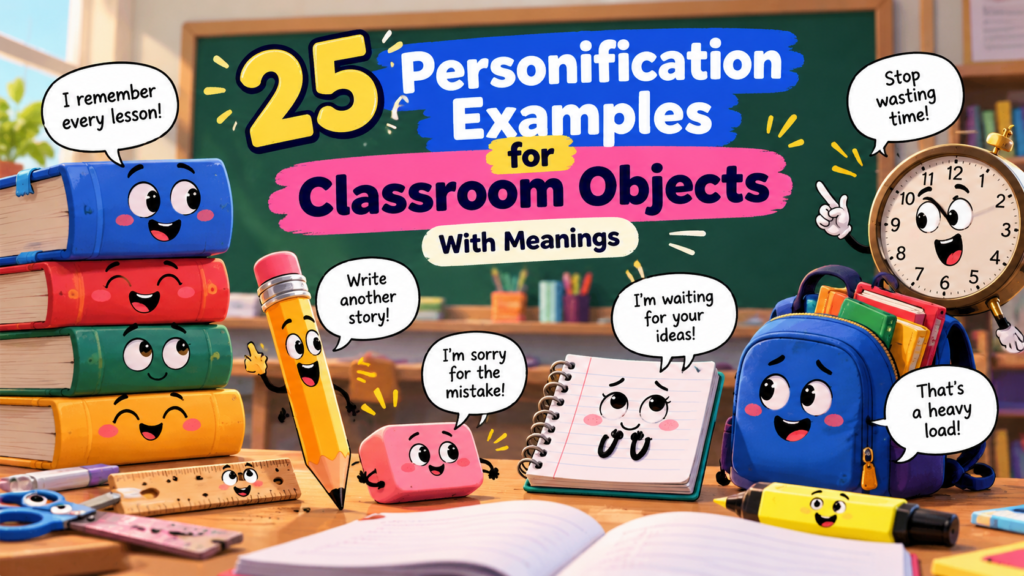
A classroom is filled with ordinary objects that students use every day. Pencils help us write, clocks show the time, and books contain information. But what if a pencil could complain, a clock could give advice, or a textbook could tell a story?
These imaginative ideas are examples of personification.
Personification examples for classroom objects help students understand how writers give human qualities, emotions, and actions to things that are not human.
Instead of writing, “The classroom clock was loud,” you could write, “The classroom clock scolded us for wasting time.”
The second sentence creates a stronger image by giving the clock a human action.
In this guide, you will explore 25 original personification examples for school objects, their meanings, sentence examples, and practical writing activities. You will also learn how to identify personification and create your own sentences.
What Is Personification?
Personification is a figure of speech that gives human characteristics, emotions, intentions, or actions to nonhuman things.
Writers use personification to make descriptions more expressive, imaginative, and interesting.
For example:
“The old classroom door complained whenever someone opened it.”
A door cannot literally complain. However, an old door might make a creaking sound that reminds someone of a person complaining.
The writer uses this human action to make the door seem more lively.
Personification commonly appears in:
- Creative writing assignments
- Poems and short stories
- Descriptive essays
- Children’s literature
- Classroom activities
- Speeches and imaginative descriptions
Personification can also help students express the atmosphere or mood of a place.
A cheerful classroom might have windows that welcome the morning sunshine. A quiet classroom might contain books that patiently wait for readers.
Both descriptions use personification to create a particular feeling.
25 Personification Examples for Classroom Objects With Meanings
The following examples use familiar classroom objects, including pencils, books, clocks, desks, whiteboards, and other school supplies.
Each example includes a simple meaning and a sentence showing how the personification works in context.
1. The Pencil Begged Me to Finish My Story
Personification: “The pencil begged me to finish my story.”
Meaning: The pencil is described as if it can speak and ask someone to continue writing.
Example sentence: “After staring at my unfinished paragraph for several minutes, I imagined that my pencil begged me to finish my story.”
Explanation: Begging is a human action. A pencil cannot ask for anything, but this comparison creates the impression that the writing task is waiting to be completed.
This example is useful for stories about creativity, writing assignments, and finding motivation.
2. The Eraser Apologized for Every Mistake
Personification: “The eraser apologized for every mistake.”
Meaning: The eraser is imagined as feeling responsible for the errors it removes.
Example sentence: “As I corrected my mathematics homework, the little pink eraser apologized for every mistake on the page.”
Explanation: Apologizing is something people do when they express regret.
An eraser cannot feel sorry, but giving it this ability creates a playful description of correcting schoolwork.
3. The Classroom Clock Scolded Us for Wasting Time
Personification: “The classroom clock scolded us for wasting time.”
Meaning: The clock is imagined as a strict person reminding students to work quickly.
Example sentence: “During our final writing exercise, the classroom clock scolded us for wasting time.”
Explanation: Scolding is a human behavior. The clock only measures time, but the comparison makes it seem like an impatient teacher.
This example is particularly useful when describing a classroom test or an approaching deadline.
4. The Whiteboard Remembered Every Lesson
Personification: “The whiteboard remembered every lesson.”
Meaning: The whiteboard is described as if it has a memory of the information written on it.
Example sentence: “Although the teacher erased the equations, the whiteboard seemed to remember every lesson from the busy school day.”
Explanation: Remembering is a mental ability associated with people.
The whiteboard does not actually remember anything. The personification helps the writer imagine how many lessons have taken place in the classroom.
5. The Old Desk Welcomed Another Student
Personification: “The old desk welcomed another student.”
Meaning: The desk is imagined as greeting the student who sits beside it.
Example sentence: “On the first morning of school, the old wooden desk welcomed another student into the classroom.”
Explanation: Welcoming someone is a human social action.
The desk cannot greet a student, but this sentence makes the classroom feel friendly and inviting.
6. The Textbook Whispered Forgotten Stories
Personification: “The textbook whispered forgotten stories.”
Meaning: The book is described as quietly sharing information from the past.
Example sentence: “As I opened the history textbook, its yellow pages seemed to whisper forgotten stories.”
Explanation: Whispering is a human way of speaking softly.
The textbook cannot talk. The writer uses personification to suggest that the book contains interesting information waiting to be discovered.
7. The School Bell Shouted That Class Was Over
Personification: “The school bell shouted that class was over.”
Meaning: The bell’s loud ringing is compared to a person shouting an announcement.
Example sentence: “Just as the teacher began another explanation, the school bell shouted that class was over.”
Explanation: A bell produces sound, but it does not literally speak or shout words.
The sentence gives the bell a human action to make the moment more dramatic.
8. The Notebook Patiently Waited for New Ideas
Personification: “The notebook patiently waited for new ideas.”
Meaning: The notebook is imagined as a patient person expecting something to happen.
Example sentence: “My empty notebook patiently waited for new ideas while I searched for the perfect opening sentence.”
Explanation: Patience is a human quality.
A notebook cannot experience waiting or anticipation, but this description makes an empty page feel full of possibilities.
9. The Ruler Stood Guard Over My Straight Lines
Personification: “The ruler stood guard over my straight lines.”
Meaning: The ruler is compared to a guard protecting the accuracy of the student’s work.
Example sentence: “During our geometry lesson, the ruler stood guard over every straight line I drew.”
Explanation: Standing guard is a deliberate action associated with people who protect something.
The ruler helps create straight lines, but it cannot intentionally protect them.
10. The Backpack Complained About Its Heavy Load
Personification: “The backpack complained about its heavy load.”
Meaning: The backpack is imagined as feeling tired of carrying books and supplies.
Example sentence: “As I walked home from school, my backpack complained about its heavy load of textbooks.”
Explanation: Complaining expresses a person’s dissatisfaction.
A backpack does not have feelings, but the sentence suggests how heavy the school supplies seem.
11. The Scissors Argued With the Paper
Personification: “The scissors argued with the paper.”
Meaning: Cutting difficult material is described as an argument between two objects.
Example sentence: “During the art project, the scissors argued with the thick paper as I tried to cut a perfect circle.”
Explanation: Arguing is a human activity involving disagreement.
Neither scissors nor paper can argue, but the comparison turns a difficult cutting task into an amusing scene.
12. The Glue Stick Refused to Cooperate
Personification: “The glue stick refused to cooperate.”
Meaning: The glue stick is described as deliberately refusing to help.
Example sentence: “Just when I needed to finish my poster, the nearly empty glue stick refused to cooperate.”
Explanation: Refusing to cooperate suggests a conscious decision.
A glue stick cannot make decisions, but the comparison communicates the student’s frustration when the glue is not working properly.
13. The Classroom Chair Groaned Under the Weight of My Books
Personification: “The classroom chair groaned under the weight of my books.”
Meaning: The chair’s creaking sound is compared to a person groaning.
Example sentence: “When I placed my heavy backpack on the old chair, it groaned under the weight of my books.”
Explanation: Groaning can express human discomfort.
The chair may produce a real creaking sound, but describing that sound as a groan gives it a human quality.
14. The Paper Smiled at My Finished Drawing
Personification: “The paper smiled at my finished drawing.”
Meaning: The paper is imagined as being pleased with the student’s artwork.
Example sentence: “After an hour of careful coloring, the paper smiled at my finished drawing.”
Explanation: Smiling expresses happiness or approval.
Paper cannot smile, but the sentence creates a cheerful feeling about completing a creative project.
15. The Marker Screamed Across the Whiteboard
Personification: “The marker screamed across the whiteboard.”
Meaning: The marker’s sharp squeaking sound is compared to a human scream.
Example sentence: “The dry marker screamed across the whiteboard as our teacher wrote the day’s final question.”
Explanation: Screaming is associated with human or animal vocal expression.
The marker cannot literally scream. The personification helps readers imagine its unpleasant squeaking sound.
16. The Computer Refused to Wake Up
Personification: “The computer refused to wake up.”
Meaning: A slow or unresponsive computer is imagined as a person who does not want to get out of bed.
Example sentence: “Five minutes before our technology lesson, the classroom computer refused to wake up.”
Explanation: Refusing to wake up suggests deliberate human behavior.
Although people commonly say computers wake from sleep mode, this sentence uses the phrase imaginatively to suggest stubbornness.
17. The Projector Proudly Displayed Our Work
Personification: “The projector proudly displayed our work.”
Meaning: The projector is described as feeling proud of the students’ presentation.
Example sentence: “At the end of our group project, the classroom projector proudly displayed our colorful slides.”
Explanation: Pride is a human emotion.
The projector simply displays an image, but describing it as proud makes the moment feel like an achievement.
18. The Classroom Door Complained About Every Visitor
Personification: “The classroom door complained about every visitor.”
Meaning: The door’s repeated creaking is imagined as a person expressing annoyance.
Example sentence: “The old classroom door complained about every visitor who entered during the quiet reading session.”
Explanation: Complaining expresses dissatisfaction.
The door cannot experience annoyance, but its creaking sound helps support the imaginative comparison.
19. The Window Invited the Morning Sunshine Inside
Personification: “The window invited the morning sunshine inside.”
Meaning: The window is imagined as welcoming sunlight into the classroom.
Example sentence: “As our morning lesson began, the wide classroom window invited the sunshine inside.”
Explanation: Inviting someone is a deliberate social action.
The window simply allows sunlight to pass through it, but the personification creates a warm, friendly atmosphere.
20. The Classroom Globe Dreamed of Distant Countries
Personification: “The classroom globe dreamed of distant countries.”
Meaning: The globe is imagined as thinking about places around the world.
Example sentence: “While we studied geography, the colorful globe dreamed of distant countries and unfamiliar oceans.”
Explanation: Dreaming involves mental activity.
A globe cannot imagine or dream, but the sentence encourages students to think about travel, exploration, and distant places.
21. The Calculator Celebrated the Correct Answer
Personification: “The calculator celebrated the correct answer.”
Meaning: The calculator is imagined as being happy when a student solves a problem.
Example sentence: “When the final calculation matched my homework answer, the calculator celebrated my small victory.”
Explanation: Celebrating is a human expression of happiness or achievement.
A calculator processes numbers, but it cannot feel excitement about the result.
22. The Wastebasket Swallowed My Failed Attempts
Personification: “The wastebasket swallowed my failed attempts.”
Meaning: The wastebasket is imagined as eating discarded pieces of paper.
Example sentence: “After several unsuccessful sketches, the wastebasket swallowed my failed attempts.”
Explanation: Swallowing is an action associated with living creatures.
A wastebasket cannot eat, but the comparison creates a vivid image of paper disappearing into it.
23. The Pencil Sharpener Grumbled Through Another Pencil
Personification: “The pencil sharpener grumbled through another pencil.”
Meaning: The sharpener is imagined as complaining while working.
Example sentence: “The tired pencil sharpener grumbled through another pencil as our art lesson continued.”
Explanation: Grumbling is a way people express annoyance.
A sharpener may make a rough mechanical sound, but it cannot complain about its work.
24. The Classroom Map Told Stories of Faraway Places
Personification: “The classroom map told stories of faraway places.”
Meaning: The map is imagined as a storyteller introducing students to different countries and regions.
Example sentence: “During geography class, the enormous wall map told stories of faraway places we hoped to visit.”
Explanation: Storytelling is a human activity.
A map cannot speak, but its locations can inspire people to imagine journeys and experiences.
25. The Highlighter Cheered for Every Important Idea
Personification: “The highlighter cheered for every important idea.”
Meaning: The highlighter is imagined as celebrating useful information.
Example sentence: “As I revised my science notes, the yellow highlighter cheered for every important idea on the page.”
Explanation: Cheering expresses enthusiasm or approval.
A highlighter cannot feel excited, but its bright color helps emphasize information that matters to the student.
Quick Table: Classroom Object Personification Examples
The table below summarizes ten classroom personification sentences and their meanings.
| Classroom Object | Personification Example | Human Quality |
|---|---|---|
| Pencil | The pencil begged me to write. | Begging |
| Eraser | The eraser apologized for mistakes. | Apologizing |
| Clock | The clock scolded the students. | Scolding |
| Whiteboard | The whiteboard remembered lessons. | Remembering |
| Desk | The desk welcomed a student. | Welcoming |
| Textbook | The textbook whispered stories. | Speaking |
| Backpack | The backpack complained about its load. | Complaining |
| Window | The window invited the sunshine. | Inviting |
| Calculator | The calculator celebrated the answer. | Celebrating |
| Highlighter | The highlighter cheered for ideas. | Cheering |
These examples show that personification often involves giving an object human emotions, intentions, or behaviors.
Why Do Writers Use Personification for Classroom Objects?
Personification is more than a way to make ordinary objects sound unusual.
It can help students develop creativity, build a particular mood, and communicate ideas through imaginative descriptions.
1. It Makes Writing More Interesting
Compare these two sentences:
“The old door made a loud sound.”
“The old door complained whenever someone opened it.”
The second sentence gives the door a human action and helps readers imagine the scene.
2. It Helps Create a Mood
Personification can make a classroom feel cheerful, mysterious, stressful, or welcoming.
For example:
“The classroom windows welcomed the morning sunshine.”
This sentence creates a peaceful atmosphere.
Now consider:
“The classroom clock angrily warned us that time was running out.”
This creates a more urgent atmosphere.
The human actions given to the objects affect the mood.
3. It Encourages Creative Thinking
Students can develop original ideas by imagining what everyday objects might say or feel.
A pencil might be excited to begin a new story, while a tired backpack might complain about carrying too many books.
These ideas help learners experiment with language.
4. It Makes Descriptions More Memorable
A reader may quickly forget a sentence such as “The desk was old.”
However, “The old desk welcomed another generation of students” creates a more unusual picture.
Personification can make an ordinary classroom object part of the story.
Personification vs. Metaphor vs. Simile
Students sometimes confuse personification with metaphors and similes.
Although all three are types of figurative language, they use comparisons differently.
| Type | Example | Explanation |
|---|---|---|
| Personification | The pencil begged me to write. | Gives a pencil a human action |
| Metaphor | The classroom was a beehive. | Directly compares a classroom with a beehive |
| Simile | The classroom was like a beehive. | Compares using like |
| Literal Language | The pencil rolled off the desk. | Describes an ordinary physical action |
Personification focuses on human qualities given to something nonhuman.
Metaphors and similes compare things to communicate shared qualities.
Sometimes a sentence can involve more than one literary technique. The important skill is understanding how the language works in context.
You can practise identifying different techniques with the Figurative Language Checker.
The checker identifies possible language patterns and provides learning suggestions rather than a guaranteed interpretation.
How to Write Personification Sentences for School Objects
Creating original personification examples is easier when you follow a simple method.
Step 1: Choose an Object
Start with something familiar in your classroom.
For example:
- Pencil
- Notebook
- Whiteboard
- Clock
- Chair
Think about what the object normally does.
A pencil writes, a notebook holds information, and a clock shows time.
Step 2: Choose a Human Quality
Now think about an action or emotion usually associated with people.
Examples include:
- Laughing
- Complaining
- Remembering
- Dreaming
- Welcoming
- Celebrating
Choose a quality that relates to the object’s real function or appearance.
Step 3: Combine the Object and Action
Imagine that the object can behave like a person.
Ordinary sentence:
“The notebook was empty.”
Personification:
“The notebook patiently waited for my next idea.”
This changes a simple description into an imaginative sentence.
Step 4: Add Context
Context makes the sentence more meaningful.
For example:
“After a long morning of lessons, my notebook patiently waited for the story I had promised to finish.”
The additional information helps readers understand the situation.
Step 5: Check the Human Quality
Ask yourself whether the object has received a genuinely human characteristic.
For example:
“The classroom clock ticked loudly.”
This sentence is mostly literal because a clock can actually tick.
“The classroom clock scolded us for wasting time.”
This is personification because scolding is a human action.
The distinction is important when completing figurative language activities.
Classroom Personification Examples for Different Grade Levels
Students of different ages may benefit from different types of examples.
Grades 3–5: Simple Personification
Younger students can begin with clear, familiar actions.
Examples:
- The pencil begged me to write.
- The clock shouted that school was over.
- The backpack complained about its books.
- The window welcomed the sunshine.
- The notebook waited for a new story.
These sentences use recognizable human actions.
Grades 6–8: More Descriptive Personification
Middle school students can develop their personification with additional details.
Examples:
- The tired whiteboard remembered every difficult lesson from the week.
- My backpack complained bitterly as I climbed the final staircase.
- The classroom door welcomed us with a familiar creak.
- The history textbook whispered stories from centuries ago.
- The clock impatiently reminded us that the final minute was disappearing.
These descriptions combine human qualities with a specific classroom situation.
Grades 9–12: Personification With Mood and Theme
Older students can use personification to communicate more complex ideas.
Examples:
- The empty notebook challenged me to turn uncertain thoughts into a meaningful story.
- The classroom clock judged every moment of hesitation during the final examination.
- The faded wall map invited us to imagine the journeys of earlier generations.
- The silent whiteboard guarded the memories of lessons that had changed our understanding.
- The old desk welcomed each new student without revealing the stories it had witnessed.
These sentences can support themes such as learning, uncertainty, change, and memory.
Personification Practice Activity for Students
Use the following exercise to practise identifying personification.
Read each sentence and decide whether it contains personification.
| Sentence | Personification? |
|---|---|
| 1. The pencil rolled off the desk. | Yes / No |
| 2. The notebook begged for another story. | Yes / No |
| 3. The window welcomed the sunshine. | Yes / No |
| 4. The calculator displayed the number 45. | Yes / No |
| 5. The school bell announced the end of the lesson in an angry voice. | Yes / No |
| 6. The chair stood beside the desk. | Yes / No |
| 7. The old textbook whispered about ancient cities. | Yes / No |
| 8. The scissors cut the colored paper. | Yes / No |
Answer Key
- No. Rolling is an ordinary physical movement.
- Yes. Begging is a human action.
- Yes. Welcoming is a human social action.
- No. Displaying numbers is a calculator’s normal function.
- Yes. The bell is given an angry human voice.
- No. Standing beside something describes the chair’s position, not necessarily a human quality.
- Yes. Whispering stories gives the textbook a human ability.
- No. Cutting is the scissors’ ordinary function.
Teachers can create additional printable exercises with FigureFluent’s Figurative Language Worksheet Generator.
Students can also use our Figurative Language Quiz to practise identifying metaphors, similes, personification, and hyperbole.
Five Creative Writing Prompts Using Personification
Try these short writing activities to develop your own sentences.
Activity 1: A Talking Pencil
Imagine that your pencil could speak.
What would it say after a long writing lesson?
Write three sentences that give your pencil human thoughts or emotions.
Activity 2: The Classroom After School
Imagine an empty classroom after all the students leave.
Describe what the desks, chairs, books, and clocks might do if they could behave like people.
Activity 3: A Tired Backpack
Think about everything a school backpack carries.
Write a short paragraph describing how the backpack might complain about its day.
Activity 4: The Helpful Whiteboard
Imagine a whiteboard that remembers everything written on it.
Write a short story about what it might teach a new student.
Activity 5: The Impatient Clock
Describe a classroom examination from the perspective of a clock that is tired of waiting.
Use personification to make its personality clear.
Common Mistakes When Writing Personification
Confusing Ordinary Actions With Human Actions
Not every action performed by an object is personification.
For example:
“The clock ticked.”
This is a normal action for a clock.
“The clock laughed at my slow progress.”
This is personification because laughing at someone’s progress is a human-like behavior.
Giving an Object an Unclear Quality
A personification sentence should communicate an understandable idea.
For example:
“The ruler ate the sky.”
Although imaginative, the meaning is unclear without additional context.
“The ruler proudly guarded my carefully drawn lines” has a more understandable connection to the object’s function.
Using Too Many Human Actions
Giving every object several emotions and actions can make writing difficult to follow.
Choose one or two meaningful details rather than forcing personification into every sentence.
Repeating the Same Verbs
Writers often use words such as smiled, cried, or danced repeatedly.
Try varying your descriptions with actions that fit the object.
For example, a textbook could remember, a backpack could complain, and a clock could scold.
Forgetting the Mood
Personification should fit the overall feeling of the story.
A cheerful classroom scene might include a window welcoming the sunshine.
A stressful classroom scene might include a clock angrily warning students about time.
The quality you choose should support your intended message.
Frequently Asked Questions About Classroom Personification
What are some examples of personification for classroom objects?
Examples include “The pencil begged me to write,” “The backpack complained about its books,” and “The classroom clock scolded us for wasting time.” Each gives a nonhuman object a human quality.
What is a good personification example for a pencil?
“The pencil begged me to finish my story” is a clear example. A pencil cannot speak or beg, but the sentence describes it as if it could.
How can I personify a classroom clock?
You could write, “The classroom clock impatiently reminded us that time was running out.” This gives the clock the human quality of impatience.
What is a personification sentence for a school bag?
“My school bag complained about carrying another heavy textbook” is an example. The bag is imagined as expressing dissatisfaction with its load.
Can a book be an example of personification?
Yes. “The history book whispered stories from the past” gives the book the human ability to speak.
What is the difference between personification and a metaphor?
Personification gives human qualities to something nonhuman. A metaphor describes one thing directly as another to communicate a comparison. The techniques can sometimes overlap.
Is “the clock ticked” personification?
No, not by itself. A clock can literally tick. However, “the clock scolded me for being late” is personification because scolding is a human action.
Why is personification useful in school writing?
Personification makes descriptions more imaginative, helps establish mood, and encourages students to think creatively about familiar objects and situations.
Can personification be used in a serious essay?
Yes, particularly in descriptive, reflective, or literary writing. However, formal academic essays may require more direct language, depending on the assignment and audience.
How can teachers help students practise personification?
Teachers can ask students to choose classroom objects, assign human actions to them, explain the meaning, and write short descriptions. Printable worksheets and interactive quizzes can support this activity.
Final Thoughts
Personification makes ordinary classroom objects more interesting by giving them human qualities, emotions, or actions.
A pencil can beg for another story, a textbook can whisper about history, and a school clock can impatiently remind students that time is passing.
These imaginative comparisons help students develop descriptive writing skills and better understand figurative language.
The most effective personification examples are clear, meaningful, and connected to the object being described.
Whether you are completing an English assignment, preparing classroom activities, or practising creative writing, try choosing an everyday school object and imagining what it might say or feel.
For more interactive examples, exercises, and free writing tools, explore FigureFluent. You can also practise related comparisons with our Figurative Language Sentence Transformer.
Leave a Reply